


What does it mean to become 'awakened?' Do you even want to be?
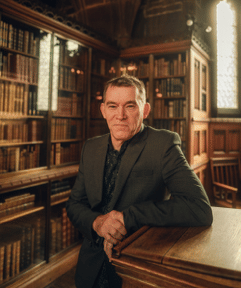
Steve Taylor is from Leeds Beckett University and is the best-selling author of the book, 'The Adventure: A Practical Guide For Spiritual Awakening." He writes for Scientific American and Psychology Today.
Eckhart Tolle has described his work as ‘an important contribution to the shift in consciousness which is happening on our planet at present.’
Steve tells Jim that you can cultivate your conscious transition with these steps.
Then, he jumps into 'Time Expansion Experiences' and even a bit about the spiritual evolution of the Beatles.
Join in the adventure with us today!
Looking for a fun take on modern spirituality? You've come to the right place. From new thought tools to the science behind the metaphysics, dive into interviews with the most interesting people in open spirituality and self-development. It's a big universe, and I'm your host, Jim Lefters. Hi there. Welcome to Big Universe. My name is Jim Lefter. I'll be today's host. As always, I'm a spiritual journeyman and media producer type guy, and that's still true. We've got some really enlightening stuff for you here today. We're going to get into some little things like steps to becoming awakened and a little bit of time talk and, you know, just the nature and reality of time. little subjects. My guest today is Steve Taylor. He's a senior lecturer in psychology at Leeds Beckett University and the author of best-selling books on psychology and spirituality, including two that we're going to focus on today, The Adventure, A Practical Guide for Spiritual Awakening, and hopefully we'll be able to get to a little bit of time expansion experiences. You've got so many good books, and I also want to hear, I know you're you're writing a book or you've written a book on the Beatles, and I love the Beatles. I'm wearing a Beatles t-shirt right now. Steve's the past chair of the Transpersonal Psychology section of the British Psychological Society. He regularly appears in the media in the UK, including Radio Force, Prayer for the Day, and the BBC World Service. He writes blog articles for Scientific America, The Conversation, and Psychology Today. Eckhart Tolle has described his work as an important contribution to the shift in consciousness which is happening on our planet at present. You can find out more about him at stephenmtaylor.com. Steve, welcome to Big Universe. I'm so thrilled to have you on. Hi, Jim. Great to be with you. That's a lot of words. You've done a few things. I guess so. I think my book on the Beatles is probably my 18th book. Wow. Wow. And plus you do the blogs and, and I've really enjoyed, you know, if we can, I want to touch on some of your really interesting blogs, um, on, on current events in, in your, in psychology today's, um, work. Um, I know we don't have a lot of time to get in all that stuff, but I guess my first question for you is what kind of drove you to the work you're doing at this kind of intersection of psychology and science and consciousness, spirituality. What, what drew you to that? How'd you get there? It was very instinctive. I didn't have a mentor or a guide or anything like that. It just seemed to be inside me from a young age. Uh, but I didn't have any, I didn't have any knowledge about spirituality or even psychology when I grew up. Um, But when I was a teenager, I started to experience unusual states of consciousness in which I'd feel a sense of euphoria and I'd feel connected to my surroundings. I didn't really understand what was going on. I thought maybe I was crazy. Probably, possibly I was. But at least I had the good sense not to tell my parents about the experiences because they would- They would have been complicated probably, yeah. Yeah. They would have probably sent me to see a psychiatrist. But when I was about 22, I discovered a book which was called Mysticism, a Study and Anthology by a gentleman called F.C. Happold, an English scholar of mysticism. And it was a very important book for me because it was the first time I'd read texts about spirituality or mystical experiences. It was an anthology of many of the world's spiritual texts like the Upanishads and the Tao Te Ching. So it was a real revelation. I thought, well, maybe I'm not crazy after all. Or maybe I am, but all these other people are crazy too. So after that, I defined myself as a spiritual person. So I started to explore this whole vast landscape of spirituality. What does spirituality mean to you? Do you have a concept of God, the universe, connection, higher state of consciousness, whatever you want to call it? What does it mean to you? To me, it's really nothing to do with religion necessarily. as it is normally understood, or even to do with God, as we normally understand God. Obviously, it depends on how you define these terms. Well, to me, spirituality isn't necessarily anything to do with what we know as spiritual traditions, like Buddhism or Hinduism or Taoism. I mean, obviously, these are expressions of spirituality, but spirituality can exist outside those traditions. To me, spirituality really means, I think I define it in terms of two terms. The first is expansion in terms of an expansion of awareness beyond our normal limited awareness of reality. Barriers seem to fall away and we gain a much more intense and expansive awareness of reality. And also the second term is connection. Spirituality is about transcending our normal sense of separation and our normal feeling of being somebody who lives inside our minds and bodies, somebody who's separate to the rest of the world and separate to other people. So we transcend that separation and we become increasingly connected to other people, to nature and to the whole cosmos. So spiritual awakening is a process of expanding awareness and also a process of increasing connection. This book, The Adventure, really awesome. And it takes you on steps to realize this experience of awakening, perhaps. Some people would say it's not something you should be doing. It's something that comes to you. It's being. You have steps to get in this consciousness. And I'm wondering, what do you say to that idea? That's true in a sense. Spirituality is a state of being, and it can arise spontaneously and accidentally. But it doesn't just have to arise spontaneously and accidentally. You can cultivate it. That's the basic insight of all spiritual traditions, from Buddhism to Taoism to Hindu yoga and Vedanta. You can cultivate spiritual awakening. You can undergo conscious awakening. spiritual development, there are some spiritual teachers who say, well, you know, whenever you consciously try to do something, that actually reinforces the ego, and it becomes an obstacle to spiritual development. But I don't agree with that. I think that there is an organic, deep-rooted impulse inside human beings. It doesn't come from the ego. It comes from a place beyond or beneath the ego, an impulse to evolve. to grow, to spiritually develop. So it's not a question of consciously trying to become awakened. It's a question of following that deep-rooted, authentic, organic impulse to awaken. Okay, so two questions to follow up on that. First off, can you give me a little bit more of an idea of what does it mean to be awakened? And Why should we want to? It means, in relation to what I just said before, it means living in a state of expansive and intensified awareness. And I break that down into four main areas. First of all, there is an intensified perceptual awareness that means the world around you is intensely real. It's as if a veil of familiarity falls away. Everything is more vivid and more fresh. And things look more interesting and exciting and fascinating. So if someone is spiritually awakened, they find a lot of joy just in looking at things, just being in nature and being aware of the reality and the beauty of nature. And they're a bit like children, the way children are kind of fascinated by things that seem mundane and unordinary to adults. Being spiritually awakened is a bit like that in a perceptual sense. It also means an intensified sense of subjective awareness, which means that we become aware of our own inner being in a more intense way. We become aware of depths and levels of our own inner being, which we weren't aware of before. I compare it to, in a normal state, it's like we're living in an attic room in a big house, and we think the attic room is a whole house. We never even try to go beyond it. When you undergo awakening, you're suddenly aware, wow, There are so many floors beneath this attic. There are so many rooms to explore. So your inner awareness expands. The third one is there's an expansion of what I call intersubjective awareness, which means that you become increasingly connected to other people. You become more empathic, more compassionate, more altruistic. Another not just to other people, but also to nature. You feel more connected to the natural world, to other living beings, to animals and other species. And the fourth thing is there is an expansion of what I call conceptual awareness, which means that you have a more wide-ranging understanding more global perspective on reality. You don't just see things from an egoic and now egoic perspective. You become aware of the kind of global or cosmic, even a cosmic perspectives. So, you know, some people have a sense of group identity. They feel that they are affiliated with their ethnic or national or political identity. But in awakening, we transcend that kind of group identity with a much more wide ranging sense of identity. If we identify with anything, we identify with the human race as a whole rather than any particular group or just with the universe as a whole. So that's how I would define awakening, that expansion of awareness. Oh, exactly part of your question, why? Well, that's a good question. I'd say the main reason is because the world is in a completely dysfunctional state at the moment. Oh, that's true. Many human beings live dysfunctional lives with a lot of discord in our lives, a lot of conflicts in the world, a lot of discord, a lot of depression, boredom, addiction, all of these things. And essentially, they're all caused by a lack of spiritual awakening. When you awaken to some degree, these problems and pathologies begin to fall away, both on an individual level, and on a collective level. If the whole human race was spiritually awakened, we would be living on a completely different planet. There would be no warfare, no conflicts over territory, no mass epidemics of addiction and depression and so forth. I like that idea. I really kind of like that idea. Yeah, it would be great. So, I want to get into some of the steps of awakening, but first I have a question. You know, there are some people, primarily from, I think, a materialistic science perspective that say this higher consciousness idea is basically a construct of the brain, the mind, but what you indicate is that there's a greater connection in the So do you think this consciousness is outside of us or interconnected with us or biological? To me, it's both. It's not biological. You can't reduce it. Partly biological, but you can't reduce it entirely to biology. Human consciousness is much more than the product of brain cells whirring around and interconnecting. It's true that there are some scientists who try to reduce spiritual experiences to unusual brain activity, even to the extent that it's something aberrational. Part of the brain is not working very well. The part of the brain that creates a sense of boundaries isn't working, so you feel connected to everything. But there are loads of problems with that. First of all, nobody has ever identified any particular part of the brain which is responsible for awakening experiences. People have tried, but that findings have never been replicated. There's no agreed part of the brain or brain process that produces these experiences. And then there's a whole problem of explaining any conscious experiences in terms of brain activity, which some philosophers call the hard problem. The idea. That something as rich and intense as your conscious experience could be produced by the matter of your brain. And I. Think consciousness should be seen as something universal and fundamental. It's not something that is produced by the brain. It's something which is built into reality itself and something which all living beings and all inanimate things are manifestations of. So when we feel a sense of connection in awakening experiences, we're really experiencing the fundamental and universal consciousness, which is in everything. You emphasize in the book eight qualities for awakening as kind of a highlight on the path to awakening. And I want to dive into those a little bit. I'll mention them all, and you can pick and choose what you want to follow here, or I can. I'm always happy to do that. But the ones you list, I'll just list them here, are disidentification from the ego, gratitude, presence, altruism, acceptance, integration with the body, dissolving psychological attachments, embracing our mortality. Do you want to dive into any one in particular or should I jump in? Well, these characteristics have emerged from my research as a psychologist, my research with spiritually awakened people. I did over 100 interviews initially. with spiritually awakened people. And there were 16 characteristics which emerged, which these people exemplified and which differentiated them from other people. And in my book, The Adventure, I hone in on eight characteristics, which I feel are the most important and which also are the easiest to operationalize on a practical basis. And they're all really equally important. Gratitude is a good example. I found in my research that one of the basic qualities of spiritually awakened people was an ongoing sense of gratitude. I think that most people suffer from what I call the taking for granted syndrome. It's kind of natural for human beings that we tend to take things for granted. We tend to take our health for granted when it's okay. We tend to take people for granted. And life itself, we tend to take life itself for granted. But when people undergo an awakening, that sense of taking for grantedness fades away. They're aware, continually aware of the specialness or the preciousness of the things in their lives. And once you have that sense of gratitude for a whole range of things, for life itself, but also for your health, for people, for nature, for the basic privileges of life, like a sense of security and so forth. It informs every aspect of your life and it becomes impossible to be depressed, really to feel any negative emotions because it infuses you completely. It infuses your perspective on life completely. So in the book, I suggest a number of exercises that people can utilize to to cultivate a sense of gratitude along with some meditations. And the basic idea of the book is really that if you cultivate these qualities, these essential qualities of wakefulness, then inevitably you will experience wakefulness itself. You mentioned an analysis of astronauts who've had experiences that have changed them in form... in forms of gratitude. Mention that a little bit. I did some research on the American astronauts who went to the moon in the late sixties and early seventies. There weren't many, I think it was, I can't remember exactly. Was it about 14? I think something like that. But a lot of them had transformational experiences. They returned to the earth as different people. And one element of their transformational experiences was was a sense of gratitude. There was one astronaut, Rusty Schweickart, and he described looking at the Earth from space and being aware that everything that you enjoy and love and savour is on that tiny planet in the midst of the nothingness of space. He described it as this beautiful blue-green pearl, and every place he loved, every person he loved, every activity he enjoyed was there. on that tiny planet. He felt this incredible sense of gratitude for the Earth and for his life on Earth. Another guy called Alan Bean, he said that later in his life, I think when he was in his 70s, he said that when he came, ever since his return from the moon, he'd never complained about the weather. He was just glad that there was weather. And he said that after he came back from the moon, he used to just sit in shopping malls And he just watched people go by and think, wow, this is a miracle. This is the miracle of life on earth. You know, why do people complain? We're living in the Garden of Eden, he said. So I have an exercise, a visualization exercise, where I I take people on a journey to the moon and we try to cultivate that sense of gratitude for life on earth. You have a friend that answered a question differently than than you would and the question was would you choose to be born Sometimes I have that question too. I'm not sure because, you know, if I have to reincarnate, I don't know if I believe in reincarnation, but I feel like I've done it for now. What do you say to why would you choose to be born? It's a good question. It's an old philosophical question. The Greek philosophers used to say, it is better never to have been born because life is so full of suffering. and discord. And you're right, yeah, my friend said that to me one night in the pub. He said to me, Steve, if you knew what life was going to be like, would you have chosen to be born? And he said, I definitely wouldn't, now that I know what life is like, that it's got so much suffering and challenge and crisis. And I thought for a moment, and I said, of course I would have chosen to be born. But it depends on your perspective. I think if you experience life in a state of separateness, as we described earlier, which I guess is the normal human experience, and you feel that you're an entity living in here and the rest of the world is out there, and the world sort of seems like a familiar, mundane place, you're repeating the same experiences, you're doing the same job every day, living in the same house, I can kind of see things from that perspective. But I don't really get it because for me, life is, it is a kind of miracle. It's a miracle that I'm here on the surface of this planet for a certain amount of time. It's a miracle that I inhabit this miraculous body which is performing millions of biological functions every moment to keep me healthy and alive. It's a miracle that My life consists of a number of people who I see regularly, like members of my family, these strange, beautiful beings who I share my house with. They can be strange, but they are beautiful. That's right. So it's all a kind of miracle from that perspective. And, you know, life can involve challenges and difficulties, stress and so forth. But nevertheless, I always think of it as a miracle and a blessing. I have a question for you that's kind of out of left field, but I think is somewhat connected. And that is, am I ever too old to become awakened? Wow, that's a good question. Well, when I did my PhD research on 25 people who reported that they were spiritually awakened, I looked into their ages, and the average age at which they underwent awakening was 32. Interesting. Yeah. But on the other hand, there is research suggesting that people undergo, or some people, undergo a natural process of spiritual development as. They get older. And one of the strange things about research into well-being is through the course of human life, is that old people are actually as happy as teenagers. The two spikes of happiness in human life are teenage years and the over 65s. And happiness actually rises from middle age onwards and peaks about the age of 70. And I. Think that is partly because of the spiritual effects of getting older. I think as you get older, you start to let go. You start to let go of ambitions, maybe even possessions. You start to become more present-centred and maybe more appreciative of life because you're more aware that life is temporary. Obviously not everybody, but I think there is an increasing natural wakefulness that arises as we get older. So yeah, we can use that natural process to cultivate more wakefulness. And I think for some of us, I think about my soul or whatever you want to call it and the path that it's on and whatever growth happens, I feel like it adds to the experience of whatever comes next. It adds to the collection of the planet. So that's how I tell myself, but I do sometimes have that question. Going back to, and somewhat related to getting older and changing our perspective, let's talk a little bit about the quality of disidentification from the ego. And one of the key parts for me that I always have to remind myself is that awakened people No, they're not their thoughts. That's probably the most important initial step in awakening. There's a story about that. When I was 24, I learned to meditate and used to go to a Buddhist center. But I found it difficult to meditate because my mind was quite busy, a bit wild and chaotic. So every time I sat down to meditate, I was supposed to have focus on my breathing, but I couldn't because my mind would just get pulled in different directions. So the meditation teacher came to me one time and said, Steve, how's the meditation going? And I said, oh, not very good, to be honest, because my mind is just too crazy. It won't settle down and I can't focus on the mantra. And he said, well, that's really good. You're making really good progress. I said, what? But he said, Well, many people don't realize that they're not their thoughts. Many people are so immersed in their thoughts that they can't even watch them. You've got the ability to stand back and observe your crazy mind. That's a really important stage. And it really made me think that many people are completely identified with their thoughts. They don't have that ability to stand back and watch their thoughts or not, not on a regular basis. But just have that ability to watch your own mind as it thinks, as it ponders over the future or gets worried about the future or thinks negatively. About the past. Just to have that ability to sense a space between you and your mind is really important. It means that you are disidentified from your mind and it means that you can potentially control your mind and calm your mind And it is the, you know, a very important stage in spiritual awakening. Throughout the book, you do give meditations to help in this process of awakening. Oh yeah, that's right. Jumping into another quality, altruism, giving to the world and shifting from, you talk about it as shifting from accumulation to contribution. And in line with that, you talk a little bit about spiritual activism. And some people say, well, if you're spiritual, you should be divorced from. The whole turmoil of the world. I don't personally believe that. How does spiritual activism and this altruism give us the process or the result we want? Again, that's something that emerged from my research because there is... a popular myth that when you become spiritually awakened, you live in a hermitage or a monastery in detachment from the world, and you don't really care what happens out there in the world because you're so immersed in your spirituality. But I found in my research that the opposite was the case, that when people became awakened, they were more concerned for the world. They were more concerned about global issues. They were more concerned about social problems. They were more concerned for the well-being of the planet and the well-being of other people. And as a consequence, they often became more active. And if you think about it, a lot of the great activists in history were spiritually developed or even awakened people, like Gandhi, Mahatma Gandhi, Martin Luther King, obviously a very spiritual guy. One of my favorite examples is Florence Nightingale, famous, who founded the nursing profession and made loads of social and medical and health advances here in the UK, which spread around the world. She was a very spiritually developed person. She later wrote a book about mysticism. Oh, did she? I didn't know that, yeah. Yeah, people don't know that, but she was a very spiritually awakened person. She was famous for her incredible energy. They called it Nightingale energy, but she just never stopped. She was constantly active and had this incredible dynamism, which came from her spiritual awakenings. And that sense of compassion, that desire to help was the mainspring of her mission. And that came from her spirituality. So, yeah, so I firmly believe that when you undergo awakening, you feel a heightened sense of empathy and compassion for others and for the world or the human race in general, which inevitably manifests itself in activism and altruism. I want to take a, a sideway stop into one of your blogs or a couple of your blogs from psychology today, which are really interesting. And I think you talk about active activism and the, well, I'm just going to say the rich kind of are wired to be more selfish or, or act as if they're being selfish. And there's a connection to democracy in, involved with that what are how do you connect all that. Well there is a lot of research showing that rich people tend to be less altruistic and empathic than others so that begs the question are unempathic people more likely to become rich or do they become less empathic because they are rich probably a bit of both but but as i say a lot of research showing that people at lower socio-economic levels, on a communal basis, they are actually more altruistic than others. There's a famous experiment in psychology about cars, that drivers of expensive cars are less altruistic on the road than drivers of inexpensive cars. That's a good illustration. And I guess the connection to politics and democracy is... That people who are non-empathic, I sometimes call them disconnected people or even hyper-disconnected people on an extreme level. They are kind of impelled to positions of power and wealth. They feel a strong need to accumulate power and wealth, partly because they're so separate. They're so separate that they feel a sense of incompleteness. I may have heard of a few of these kind of people in today's politics. I don't know if you have, but I have. There are a few of them around, unfortunately. I once said that we should give politicians psychological profiling, and anybody who's got a low level of empathy and a high level of psychopathy or narcissism should be ejected from the government. Yeah, that would be nice. Would there be anybody left though? So that's the connection. Unfortunately, I sometimes refer to this as pathocracy. The fact that a lot of governments around the world consist of highly disconnected people with low empathy and high narcissism and psychopathy. In my mind, I do connect the idea of spiritual activism to the idea of our democracy and maintaining our democracy in the face of some opposition to that. So it's not to me, like you've been saying, it's not to me a separate thing from my spirituality. It's actually an expression of it. It is. You can't divorce it from spirituality. I mean, the fact that in our democracies, so many people who are disconnected rise into positions of power. But it's kind of like these people are from the opposite end of the spectrum. These are the least spiritual people. It would be ideal if the most spiritual people who were awakened to some degree were in positions of power. But those people are usually not interested in power. You know, who wants to be a politician? Would a spiritually developed person? Perhaps they might feel a sense of mission or a passion to make the world a better place. But they would usually do that in other ways rather than politics on a more kind of practical, you know, everyday basis. You challenge us in the section on altruism to do some life practices. And one of them is give respectful attention to everyone you meet. Feels very challenging right now. Try to do it. Want to do it. How can we make some strides in that way? Do you have any thoughts on that? It should be a daily, not even a daily, it should be a continual practice. I mean, every time you go to the supermarket, every time you get on a bus, every time you step into a taxi, every time you pass pedestrians on the street, you're interacting with other human beings. And you have the opportunity to form a connection with them. You have the opportunity to show them respect and even gratitude if they perform some kind of service for you. And if you do that, it does create a bond and it creates a sense of harmony as well. Everybody, you know, even if there's somebody working at a supermarket or on a bus who deals with a hundred people or thousands of people every day, They still may get a sense of feeling disrespected if people ignore them. But if people give them attention, if people, you know, show them gratitude or even make a friendly conversation with them, it makes them feel more respective. And I think every day you can create so many bonds through doing that. To me, the spiritual activism also means on that personal level that there are great things we need perhaps to encouraged in our society, but exactly what you're talking about, it's on that very personal level as we meet people in our daily lives. Yeah, I think everyday life is an opportunity to perform spiritual practices. Every moment of your life can be a form of spiritual practice. That includes your interactions with other people. I also recommend what I call radical friendliness. which is making conversation with strangers, starting conversations with anybody you happen to sit next to on a bus or stand next to in a line. I do this a lot myself. It always works out really well. It creates a real sense of connection, creates a sense of harmony. And it's also an exercise in mindfulness because you're giving full attention to other people in your dealings with them. My mom was astounding at that. She would get on the bus, and by the end of the bus ride, everyone would have told her their stories. She would have empathized with them and wished them a good trip. She was amazing at that. I want to have that ability. I haven't cultivated that enough, but I really appreciated that about her. It's a great thing to do. It really does create a positive atmosphere. I mean, I was the same when I was younger. I mean, I was the opposite, actually. When I was younger, I found it really difficult to do those kind of conversations, to engage in small talk. In fact, I actually hated small talk because I thought, why aren't people talking about the meaning of life or philosophy or spirituality? Why are they talking about these mundane things like the weather? Obviously, here in England, everybody talks about the weather or about football, you know. But later on, I realised that The content of the conversation is completely immaterial. It's just the fact that you're making a connection, forming a bond with somebody. Integration is another one of the qualities. And within that harmony with the body, it is a challenge for me. And I hear from you that the body is not opposed to spirit. it's a physical expression of the spirit. And I think that's a really valuable perspective. That is another myth about spirituality that it means somehow disconnecting from your body, that by cultivating the spirit, you somehow transcend the body. There are some traditions that even say the body is an illusion or the body is something unclean and animalistic. But, um, I don't get that. My perspective is more like Walt Whitman's. You know, Walt Whitman, I sing the body electric and every atom of me is sacred and beautiful. Words for that effect. And I guess that's the tantric perspective in spirituality, that the body is something holy. The body is an expression of spirituality. And again, this is something that came from my research because I found that when people underwent awakening, they actually took more care of their bodies. They started to exercise, to care about their diet and so on. So they began to treat their body as something sacred rather than something expendable. You go into embracing mortality, which I think people don't generally want to do to some extent. I think there's a great fear for a lot of people there. And what are your thoughts on... being beyond death is there do we just i mean this is a really hard question and i know no one here has a definitive answer and i don't expect you to have one but do you think that there's something beyond our physical death here is something or is it just oblivion i. Used to think that there was some form of life after death in the sense that when we die our spirit or consciousness will continue but without our personal identity. So our consciousness will return to the ocean of universal consciousness, like a wave that breaks and sort of dissipates into the ocean. But a few years ago, I actually did a lot of research. I actually went into it for a competition. There was a competition. The essay was, what is the best possible evidence for the survival of individual identity after the death of the body? In other words, what's the best evidence for the afterlife? Yeah. It was run by an organization called the Bigger. It wasn't a reality show, was it? I mean, it wasn't on TV or anything? I don't think so. Not yet. So I did a lot of research. I actually went into the competition. I actually won a prize in the end because I did a lot of research and found that there is quite significant evidence that points in the direction of the survival of individual identities. I'm thinking about evidence from mediums, from reincarnation, from after-death encounters, after-death experiences, and also near-death experiences. So on balance, I think there is the survival. I think our individual identity will survive, at least for a period. We can't say for how long. Maybe it does dissipate eventually, but I think it does survive after the death of the body. Just by chance, have you ever seen the show with Ted Danson called The Good Place? I did. I remember, yeah, watching it a few years ago. I thought that was pretty cool. I thought that was an interesting concept of going beyond the current physical existence. Very funny. I'm not saying it's the way it may actually be, But I thought it was an interesting analysis of it. Yeah, it was good. What was it called again? The Good Place. The Good Place, yeah, it was good. Good Place. There are challenges to awakening, and I feel like sometimes in this society right now, it really doesn't want us to awaken. Maybe that's just my perception, but it seems like It seems like that somewhat to me. What can we do about that? I think you're right. And in my view, that relates partly to what we were discussing earlier about. Our societies. The highest positions in our societies are largely populated by people who are extremely unawakened from the other end of the spectrum, the part of the spectrum of where people with narcissism and psychopathy are situated. I mean, I'm not, I'm not saying that all rich people are all politicians are insane or, you know, or are evil. Obviously there are some good people around, but I think largely there, there, there is a, there is a large proportion of, of these people who are extremely unawakened and they do, you know, they don't want us to be awakened. They, they want to, They want to continue to accumulate wealth and power to sustain their wealth and power. And they're not interested in awakening. They're interested in making sure that we desire material goods. They're interested in making sure that we continue to work to produce things that nobody really needs. So that's a shame. And many of these people also run corporations which were engaged in environmentally detrimental activity. That's another problem. But I also want to miss it because I think that there is an impulse for awakening which is natural within human nature. I think it always has been. That's why there are so many mystics throughout history, throughout all cultures in the world. And I actually do think that this impulse is getting stronger. And it has grown stronger over the past few decades. And I think that also goes back to the social activism part and the personal relationship part, because it seems as if when we make those personal relationships and we make them positive, it feeds this idea of awakening. I think so. Yeah. I mean, When we awaken, we definitely have an effect on our communities and our families. There's a kind of radiance that you emit when you awaken. And also there are the practical effects of the way you behave, your altruism and your benevolence. That affects people. It becomes kind of contagious. And maybe it is becoming a bit contagious at the moment, partly because of the internet. The internet is probably helping If you became spiritually awakened 100 years ago, it would probably be, if you were in a place like America or England, it would be quite difficult to understand what happened to you. You would probably think you were crazy, like I did when I was 16. But now you would find out through the internet and through other people around you quite quickly that you were going through a natural process and a positive process. So it's easier to make sense of now. I know we're making a big shift here, but I do want to talk a little bit about your time expansion experience this book, if that's okay. Sure, sure. Tell me briefly what this book is about and why you decided to write this one. It came from a car crash that I had about 12 years ago when my wife and I were driving along the highway in the middle lane, and a truck pulled out from the inside lane and bashed into the back of our car. So we were spinning around in the middle of the highway. It was quite a busy highway in the afternoon. And my immediate thought was, wow, this is dangerous. We could die. Maybe we're going to die or at least be seriously injured. And What was strange on the one hand was that I felt a sense of complete calmness as I watched, you know, the car was spinning around. I was looking behind me at the drivers. I could see the panicked faces of the drivers behind us. But everything went into slow motion. I heard the bang of the truck hitting us. That was a long pause. The car started to slowly spin round, almost as if time had stopped. And I felt I had so much time to try to think about What to do? How can I do anything to minimize the danger of an accident? So I tried out various things, like pulling up the handbrake, changing gear, and shunting the car to the left. Anyway, eventually, luckily, we span around towards the shoulder. We crashed into a barrier. And then our car came to a standstill. And I remember looking at my wife and thinking, wow. she's not injured. And I looked at my own body and thought, wow, I'm not injured. So it seemed like a miracle that we had survived with that injury. But when I thought about it, the most amazing thing was that the event probably took maybe four or five seconds in real time. But in my mind, it was much, much longer, felt like more like a minute rather than just a few seconds. So I began to do research on these experiences. And as I'm sure you know, they're very common. And I began to analyze and systematize research on these experiences. And it's really fascinating, the ideas that our concept of time as we've learned through the years may not be the only way to examine time, may not be the only way that we experience time and that your experience with the car is definitely indicative of that. That's right. We tend to think of time as something stable and objective, but in reality, it's totally flexible. It depends totally on our state of consciousness. So, I mean, accidents are one situation where time can slow down drastically. But there are lots of other situations like psychedelics, for example. If you take psychedelics, it's almost guaranteed that you'll experience a very, very slow passage of time. And if you undergo deep meditative experiences, you may experience a radical slowing of time. And so, on the other hand, sometimes time can speed up. when you're absorbed in an activity, when you're watching a really enthralling film or reading a really engrossing book, time can go really quickly. So there's nothing flexible about it. What I suggest in the book is that we can consciously control our sense of time to some degree. Do you think this is a neurological thing? Is it a psychological thing? Is it a consciousness thing what what do you think i mean what does the evidence seem to show is there a path. The evidence doesn't suggest any clear neurological correlation there doesn't seem to be any particular part of the brain at least that has so far been identified which is responsible for our sense of time so to me it's it's psychological or even spiritual our sense of time depends on certain psychological processes and structures. Most of all, I. Suggest that it depends on our normal sense of separation, which you mentioned earlier in relation to awakening. When that sense of separation fades away, then our sense of time seems to fade away too. Usually time expands drastically. So that can happen in accidents, or in meditation, or in psychedelics. The hallmark, the essence of these experiences is that they break down our normal sense of separation. You talked about four laws of psychological time. The first is time seems to speed up as we get older. And that I have definitely experienced. You know, when you're a kid, it's like, oh my gosh, I'm never going to be 10 years old. When you're 50, oh my God, I'm 60. You know what I mean? It's one of the most common human experiences. In surveys, around 90% of people agree that Christmas comes around quicker every year. And some people think it's something to do with... There's a theory which people refer to as the proportional theory. The idea is that when you're four, a year is a quarter of your whole life. So it seems to be a vast amount of time. But when you're 50... A year is like 2% of your whole life. So it seems to be insignificant. But I think it's largely to do with perception. That when you're a child, everything is new and unfamiliar. So you're taking in vast amounts of information. You're being bombarded with perceptions and impressions from the world. And also, you don't really have a sense of separation when you're a child. You don't really have a sense of ego. But as we get older, the world becomes more familiar. We develop a sense of duality, a sense of separation. And I think that's the main reason why time gets faster. What's the idea of linear time versus non-linear time? I know, you know, like in a second or two. I'm just kidding. But if you can give us a little bit of that. Well, it's a cultural thing, really. Yeah. It's a cultural thing. In Western societies, we tend to have a linear view of time. You know, we count every day that passes. We count every second that passes. And we feel as though our lives are following a straight line, like an arrow heading towards the future. And I guess that's our normal experience of time. It creates a sense of pressure because we're very aware of the future. We're very aware that time is slipping away. What's that line from a Pink Floyd song go? One day closer to death. Every day you're one day closer to death. But sometimes in spiritual experiences, that linear view of time kind of collapses and time becomes panoramic. And there's a sense of ease because you're living in the present rather than moving towards the future. So stress falls away. You feel a sense of being at ease and at home in the world. And I think that's a much more a much healthier relationship to time. Talk a little bit about your thoughts on precognition and retrocognition in relation to this. I think the evidence for precognition is pretty conclusive. I don't think there's any doubt that precognition really exists. I've had experiences myself, which were so striking that it was obvious to me that precognition is a real phenomenon And I think if you look into physics and if you look into mystical experiences, there is a different awareness of time where time becomes spatial rather than linear in the sense that the future and the past seem to exist alongside the present. This relates to ideas in physics like blocked time, The idea that the universe, time is like space, it's spread out all around us and you can move across it in the same way that you move across the landscape. Also in quantum physics, there were so many ideas that break down our normal linear concept of time. Even ideas that seem to suggest that the past or present can affect the future. The past can affect the present, the present can affect the future and vice versa. The future can affect the present, the present can affect the past. So everything sort of linear collapses into this landscape of spatial time. And there are also strange experiences such as the life we view when people are close to death. Yeah, that's fascinating. Yeah. In a few seconds, they see their whole life. Every experience of their life is spread out before them. Again, like a landscape. So to me, that suggests that in some sense, which is very difficult to comprehend, the future already exists, at least in potential or probability. So in certain states of mind, it is possible to glimpse future events. Why should we care about time? Good question. Well, in a sense, we can't get away from it. Time is life. Life is time. Time is life. Our life. We don't have to think in terms of linear time, but we can think of processes. Our whole life consists of processes. Our bodies are undergoing a process of life from birth to death. We live through the process of seasons and the process of years. Everything has a certain amount of duration. And obviously life itself has a certain duration. So while we are alive, we are in time. Time is life itself. Okay, I want to dive into the Beatles real quick, because I love the Beatles. As I said earlier to you, I'm wearing a Beatles t-shirt. Yesterday I was wearing a Beatles t-shirt, not today. I would like to say that I wore this for the show, but I actually did, and I wear this regularly. I do think they're the greatest band of all time. I'm also intrigued that you were in a loud rock band when you were younger. Tell me about the Beatles book. Tell me about your rock band experiences. Well, I now have tinnitus, which is caused by my rock band experiences. Oh, no. I've got used to it. But yeah, for maybe 15 years, from the age of 13 to 28, music was the main thing in my life. I was always in bands, writing songs and playing songs. And the Beatles were always in my life, too, from childhood. From childhood, really. My parents had the Beatles records and I listened to them as a child. And I went away from them for a while. I started to listen to other kinds of music. But later on in life, maybe in my early 20s, I returned to the Beatles. And I've always been fascinated by them, partly because they were so prolific and they evolved so quickly through so many different styles. Yeah, it's amazing how they did that. Yeah. Yeah, and I was thinking the other day, actually, if you look at the Beatles in 1964, and then you compare them to the Beatles in 1967, they're a completely different band. They're completely different individuals. And then you compare them to the Beatles of 1969, when they were breaking up. Again, they were just a completely different band. So does the book dive into that idea? What does the book exactly dive into? It's partly about the transpersonal spiritual aspects of their music and their career. Well, you know I like that. Oh, yeah. Yeah. So I talk a lot about, I mean, one amazing thing about the Beatles was that they were a group mind. There's a story about, it was from Roger McGuinn of the Birds. When they met the Beatles, he said to George Harrison, hey, George, do you believe in God? And George said, we've not decided yet. And then a few months later, another interviewer asked John Lennon, do you believe in God? And he said, Well, we've decided that we're agnostics. But everything they said was we, you know, we this, we that. They weren't individuals. So that was the remarkable thing about them was that they had. A group mind. And that was the essence of their creativity that enabled them to write and arrange and record so quickly, you know, to the extent that they were recording an average of 35 songs every year through their career. And at the same time, it's evolving so quickly into different styles and different forms of music. And it is amazing how their path, their trajectory, how they changed up during their whole process. And you just, you hear it in the music. It's just fascinating. Yeah. And also, they were so attuned to the zeitgeist of the 1960s. they were kind of expressing the zeitgeist. They were expressing changes in consciousness that happened in the 1960s. And at the same time, they were forming those changes. They were creating those changes. So that was why, you know, the Beatles, they changed so quickly. And often when bands change, they lose their audience. They kind of alienate their audience. But no matter how radically the Beatles changed, They always took their audience with them and even became more popular because they were changing in attunement with the zeitgeist. They were expressing the collective consciousness of their times. So there was something amazingly transpersonal about everything the Beatles did. I have this wonderful memory of having a conversation with my dad when he was older. And he said, you know, I was there when all the Beatles stuff was happening. I didn't understand their music then. But I get it now. When I hear Yesterday, he was born in 29. When I hear Yesterday, when I hear Let It Be and all that sort of stuff, we were wrong. I was wrong. This is good stuff. Wow. Yeah. It's also interesting. I write a lot about some of their songs, how their songs came from a transpersonal source. They were written unconsciously. Let It Be is one of my favorites. I think Let It Be is probably my favorite Beatles song. Yeah, and that was written unconsciously. It came from a dream, like yesterday. It came from a dream. One of my favorites is Across the Universe. Yeah, yeah. Which came to John Lennon, which is the title of my book. That came to John Lennon when he was on the verge of sleep, and the words just appeared in his mind, and he went downstairs to write down these words, and the rest of the lines just came to him spontaneously, very, very quickly. Well, Steve, I hate to wind things up. I have a list of 90 questions. I literally have a list of 90 questions. I can't get to them. But thank you so much for coming on Big Universe. It's been a great conversation. Likewise. Yeah, I've really enjoyed it. Thanks a lot, Jim. Great talking to you. Steve Taylor is the author of bestselling books on psychology and spirituality, including the ones we focused on today, The Adventure, A Practical Guide for Spiritual Awakening. and time expansion experiences. You can check them out at StephenMTaylor.com. Make sure you like us on Facebook. Big Universe is still there, if you are. Thanks, everybody. I'm Jim Lefter. We'll talk next time on Big Universe.